


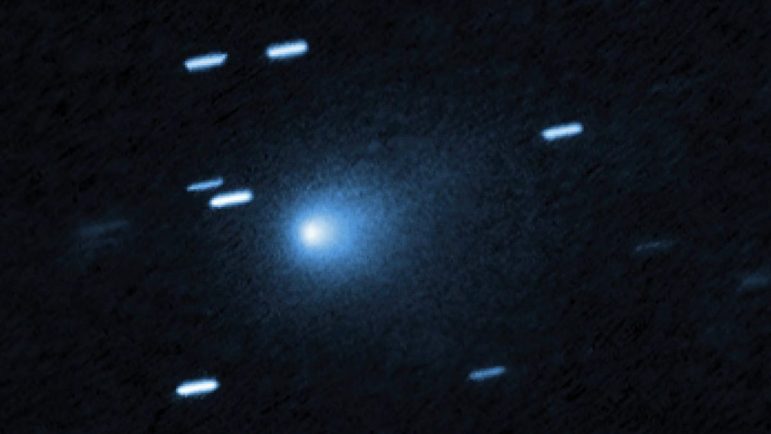
A rare interstellar visitor has entered our Solar System, and it’s behaving in ways that have astronomers both fascinated and puzzled.
Scientists say the newly discovered object shows unusual behaviour, and has sparked bold speculation about its origins.
The object, officially named 3I/ATLAS (C/2025 N1), was discovered in July 2025 by the ATLAS observatory in Chile. It is only the third confirmed interstellar object ever observed, following Oumuamua in 2017 and Borisov in 2019.
Early data show that 3I/ATLAS is moving on a hyperbolic path, which means it isn’t bound by the Sun’s gravity and will eventually leave the Solar System forever. But several features make it unlike any comet seen before.
An Odd Arrival
One of the first surprises came from its trajectory.
Most comets enter the Solar System at steep angles, coming in from the far reaches of space. 3I/ATLAS, however, is travelling almost along the plane of the planets, the same flat disc in which Earth, Mars and Jupiter orbit.
That’s unusual for an object arriving from interstellar space. According to researchers at the European Southern Observatory, this alignment “suggests a precise approach,” although they caution that chance alignments can occur. Still, it has led some scientists to wonder if the object’s path might not be entirely random.
Adding to the mystery, astronomers have observed that 3I/ATLAS appears to have two tails, one trailing behind it, as expected, and a faint one extending forward along its line of motion.
This “double-tail” configuration is rare but not unheard of. In some cases, strong outgassing from volatile materials can push dust and ions in multiple directions. Yet, the forward-pointing feature has fuelled speculation that it might reflect non-natural forces or geometry, especially among those exploring the possibility that the object could be artificial.
Now Hidden Behind the Sun
At present, 3I/ATLAS has moved behind the Sun from Earth’s viewpoint, making it temporarily invisible to ground-based telescopes. It will re-emerge into the morning sky in late October, around the time it reaches perihelion, its closest point to the Sun, roughly 1.4 astronomical units away (a little beyond Earth’s orbit).
This period of solar conjunction is frustrating for astronomers, who are eager to study its changing brightness and gas emissions as it heats up. Once it reappears, a coordinated international campaign will resume observations using both Earth-based observatories and space telescopes.
Could It Be Artificial?
Speculation about a possible alien probe has accompanied nearly every interstellar discovery since Oumuamua.
In the case of 3I/ATLAS, the discussion has been reignited by Harvard astrophysicist Avi Loeb, who argues that certain anomalies: its precise trajectory, reflective surface, and unusual tail, justify exploring non-natural explanations.
Most scientists remain cautious. Dr Brian Cox, professor of particle physics at the University of Manchester, says the idea is intriguing but unproven:
“It’s behaving oddly, but that doesn’t mean it’s a spacecraft,” Cox told reporters. “Nature can produce very strange things. Still, if it were artificial, it would be one of the most profound discoveries in history — so it’s worth keeping an open mind.”
He added that the alignment of 3I/ATLAS with the planetary plane “makes it particularly interesting, because if you were sending a probe into our Solar System, that’s exactly the route you’d take to study the planets efficiently.”
What We Know — and What We Don’t
Spectroscopic data show that 3I/ATLAS is outgassing carbon dioxide and water vapour, typical of comets. But the balance of gases is unusual: CO₂ appears to dominate, which could mean the object formed in a very cold region of its original star system.
So far, there is no evidence of radio emissions, metallic structure, or manoeuvring, signs that might hint at something artificial. However, because it’s currently behind the Sun, the window for detection is closed until it emerges again in the coming weeks.
Astronomers plan to observe it with the James Webb Space Telescope and the Vera C. Rubin Observatory, which may determine its size, shape, and rotation more precisely. Early estimates suggest it could be up to 11 kilometres (7 miles) wide, making it potentially the largest interstellar object ever observed.
A Brief Visit From the Stars
Whatever its nature, 3I/ATLAS offers an unprecedented chance to study material, and perhaps technology, from another star system. By early 2026, it will be on its way back into deep space, leaving scientists to puzzle over its origins.
“We’re witnessing something extraordinary,” said Dr Cox. “Whether it’s just a comet or something far more remarkable, it reminds us that the universe is still full of surprises.”
Key Facts about 3I/ATLAS:
Discovered: July 2025 by ATLAS Observatory, Chile
Type: Interstellar object (third known)
Closest approach to Sun: Late October 2025 (~1.4 AU)
Current position: Behind the Sun (not visible from Earth)
Unusual features: Travels along the plane of the planets; double tail; strong CO₂ outgassing
Size estimate: Up to 11 km (7 mi) wide
Artificial origin: Unproven, but not ruled out
Find out more at: https://science.nasa.gov/solar-system/comets/3i-atlas/