


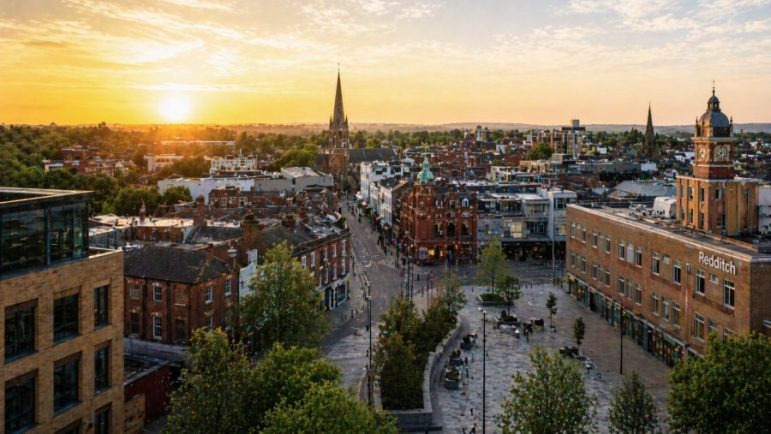
Redditch enters 2026 with the shape of the game already visible. On March 3, 2026, the borough approved a 2.99 percent rise in its share of council tax, taking the average Band D bill to £285.94 a year, while the council said it retains less than 12 percent of the total it collects. At the same time, the quarter-three monitoring report showed a forecast revenue overspend of £399,000 and capital spending of £6.776 million against a revised program of £19.921 million. That leaves the local economy leaning on delivery rather than promises: town-center work, small-business support, employability schemes, and the first serious steps toward new commercial space.
The Town Centre Has Moved First
The clearest economic signal is still in the center. By March 2026, Redditch Borough Council reported further public-realm work along Church Green East and Unicorn Hill, funded by the Town Deal, with resurfaced footways and highways, a cycle lane that also forms part of National Cycle Route 5, plus new trees, lighting, and street furniture. The outdoor market, brought back on March 29, 2025, after a four-year absence, now trades twice a week, and the current trader guide lists Thursday and Saturday hours from 9 am to 4 pm near Mercian Square. One small detail says plenty about how closely the council is now tracking the center: two geo-fences have been set up, one covering the market and one the wider public realm, so baseline footfall can finally be measured instead of guessed.
The Business Pitch Is Getting Real
If 2026 goes well, the Innovation Center will be the project that changes the conversation. Plans approved on December 19, 2025, expanded the scheme on the former police station site, and the council says the building can house up to 40 businesses at a time with office space, rentable lab space, meeting rooms, reception facilities, and shared networking areas. Another practical detail matters here: the March 2026 council update says RIBA Stages 2 and 3 are complete, Stage 4 design is moving, Speller-Metcalfe is in place up to that point, and construction is profiled to begin in summer 2026. There is already £2.425 million in LEP funding behind it, and links with Heart of Worcestershire College give the scheme a route into local skills rather than just another set of glossy boards on a hoarding.
The Jobs Picture Is Small, but It Is Moving
This part of the economy is less dramatic and more useful. The council’s February 2026 progress update said Careers Worcestershire had supported 175 people into employment support by the end of quarter three, with 62 of them getting jobs year to date; Family Hubs support had also produced 15 volunteering opportunities, 13 qualifications, and 10 people moving into work in that quarter alone. Skills Boost awarded 27 grants in quarter three and approved 76 overall, while 7 businesses accessed advisor support and 18 people attended a start-up course year to date. Cash is tight. The labor market response, though, is not standing still.
The Screen Economy Counts Too
Redditch is no longer competing only on industrial land, parking spaces, and shopfront rent. A growing share of trade now lives on the phone screen first, whether that means booking a stall, ordering lunch, checking a train time, or comparing prices before walking into a store. In that same consumer routine, best betting sites in Bangladesh sit alongside food apps, football scores, and retail checkouts as examples of products built for speed, clear navigation, and repeat visits. By early 2026, UKSPF-backed support in Redditch had already funded start-up grants, growth grants, innovation grants, energy-efficiency grants, and employee training, and the broader lesson is straightforward: firms that load quickly, explain themselves clearly, and remove friction tend to hold attention longer.
Planning Will Decide the Next Decade
The slower part of the story is planning, but it will matter more than any ribbon-cutting. Redditch’s Issues and Options consultation for the Local Plan review ran from May 22 to July 3, 2025, and covered housing, employment land, town center and district centers, infrastructure, climate change, and design coding, with site submissions still being assessed for a plan period running to 2043. That gives 2026 a specific job. It has to turn broad growth options into a map that businesses, landowners, and residents can read without guessing where the next employment land or housing pressure will land.
Phones Now Shape the High Street
Local economies are judged by convenience long before they are judged by strategy. Residents move from bus updates to online payments to football alerts in seconds, and that same habit changes what they expect from shops, markets, and public services in a town center that wants more dwell time. In that context, MelBet download belongs to the same wider mobile pattern: users reward quick entry, simple menus, and a fast route to the thing they came for. The lesson for Redditch is not about gambling. It is about service design, because market bookings, parking tools, event pages, and small-business checkout systems all lose ground when they take too many taps.
The Long Money Starts Later
The largest regeneration figure attached to Redditch will not fully come into effect in 2026, but the groundwork has already begun there. The council has confirmed £19.66 million over 10 years from the Pride in Place fund, including £150,000 of capacity funding already received, and the earlier announcement for parts of Greenlands and Woodrow set the framework at £2 million a year for a decade. The board has to be in place by July 17, 2026, with regeneration plans due to the government that autumn, and the funds available for delivery from spring 2027. Timing matters. Redditch’s economy in 2026 will develop less through one dramatic leap than through whether these linked moves start landing in the right order.