

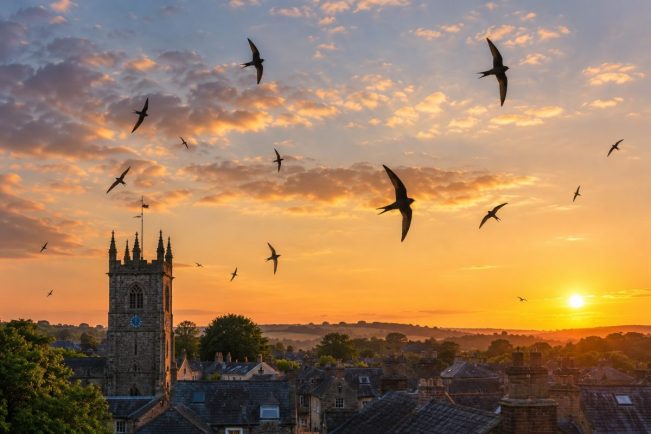
As the evenings grow warmer and the days stretch long into summer, dark shapes can often be seen racing across the sky at remarkable speed. Twisting and diving above rooftops and church towers, swifts are among Britain’s most extraordinary summer visitors.
Every year, swifts travel thousands of miles from Africa to spend just a few short months breeding in the UK before making the long journey south once again. They arrive in late spring and by June are busy nesting and raising their young.
Yet despite their annual return being one of the great signs of summer, swift numbers have fallen dramatically in recent decades.
Conservation groups estimate that Britain has lost more than half of its swift population since the 1990s. Changes to buildings, loss of nesting sites and a decline in flying insects have all contributed to their decline.
What makes swifts particularly remarkable is the amount of time they spend in the air. Outside the breeding season they can remain airborne for months at a time, eating, drinking, sleeping and even mating while flying.
Capable of reaching speeds of more than 60 miles per hour, they are among the fastest birds regularly seen in Britain.
Unlike swallows and house martins, swifts rarely perch where people can see them. Most spend their lives high above our heads, only coming down to nest in small gaps beneath roof tiles and in older buildings.
Modern construction methods have made life increasingly difficult for them. Renovations often seal up the tiny spaces that swifts have traditionally used for generations.
Conservationists are encouraging homeowners carrying out roof work to check whether swifts are nesting and, where possible, to preserve access to existing nesting sites. Special swift bricks can also be incorporated into new developments to provide safe nesting spaces.
Residents can also help by making their gardens more wildlife friendly. Swifts feed exclusively on flying insects, so planting flowers that attract pollinators and reducing pesticide use can help support the wider ecosystem on which they depend.
Many communities now hold annual “swift walks” and surveys during June and July, helping to identify nesting locations and monitor local populations.
For those willing to look up on a warm summer evening, swifts offer one of nature’s most spectacular displays. Small groups often gather high above rooftops, twisting and diving through the air with astonishing agility while calling loudly to one another.
Their arrival each year is a reminder that even in our towns and villages we remain connected to the wider natural world.
As summer unfolds, wildlife organisations are urging people to keep an eye on the skies and appreciate these remarkable visitors while they are here. After all, by late summer they will be gone again, heading south on an epic journey that few other creatures could match.
And if we want future generations to enjoy the sight and sound of swifts racing through our evening skies, protecting the places they call home has never been more important.
Did You Know? Ten Amazing Facts About Swifts
Swifts spend almost their entire lives in the air.
Outside the breeding season, swifts can remain airborne for months at a time, eating, drinking and even sleeping while flying.
They travel thousands of miles every year.
Swifts migrate between Britain and sub-Saharan Africa, covering up to 14,000 miles during their annual journey.
They are among Britain’s fastest birds.
Swifts can reach speeds of more than 60 miles per hour during level flight and even faster when diving.
A swift may not touch the ground for years.
Young swifts leave the nest and can spend the next two or three years continuously in the air before breeding for the first time.
They sleep while flying.
Scientists believe swifts can rest one half of their brain at a time while gliding at high altitude, allowing them to sleep without landing.
Swifts are not swallows.
Although they look similar, swifts are only distantly related to swallows and house martins. Their closest relatives are actually hummingbirds.
They eat thousands of insects every day.
A single swift can consume huge numbers of flying insects, helping to control insect populations naturally.
They return to the same nest year after year.
Many swifts are incredibly faithful to their nesting sites and may use the same location for decades.
They have tiny legs.
Their scientific name, Apus apus, means “without feet”. Their legs are perfectly adapted for clinging to walls and nest sites but are not designed for walking.
Britain has lost more than half its swifts.
Swift numbers have fallen dramatically since the 1990s, largely because modern buildings provide fewer nesting spaces and insect populations have declined.
Bonus Fact
The screaming calls you hear on warm June and July evenings are often swift “screaming parties”.
Groups of swifts race around rooftops and church towers at incredible speed, calling loudly to one another. For many people, it is one of the most distinctive sounds of the British summer.
Have you spotted swifts in your area this year? Let us know where you’ve seen them. We’d love to hear about your local wildlife sightings.