

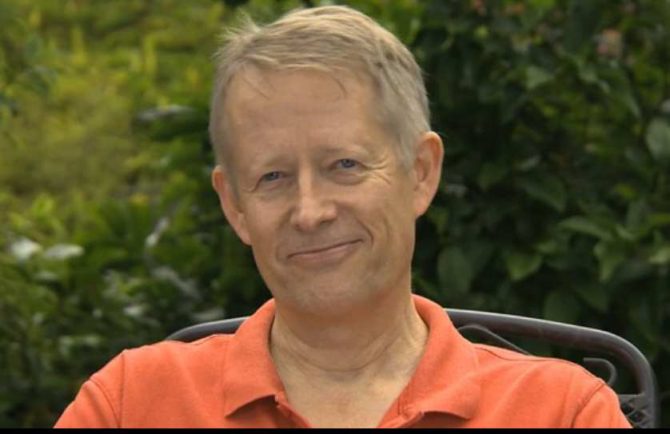
A REDDITCH man who beat cancer only to be blighted by another debilitating illness has had his life transformed thanks to revolutionary ‘super microsurgery’.
Keith Bernard, from Winyates Green, survived surgery for an aggressive prostrate cancer in August 2014, but within three months he had developed lymphoedema which caused his right leg to swell and fill with fluid making it 45 per cent bigger than his left leg.
The 60-year-old software developer said: “It was awful. I was told it was incurable and would inevitably get worse and worse.
“I was also getting really depressed. You just don’t expect to survive the cancer only to get something like this.”
It was also difficult for Keith to take part in his favourite hobby -Lindy Hop dancing.
“I would go around the dance floor and people would keep asking me how the leg was, it was that obvious. I was carrying around three and a half litres of extra fluid in my leg at one point,” he said.
“I was back dancing within four weeks of my surgery for prostrate cancer, but then the infection set in.”
However, prior to becoming a software developer, Keith had worked as a pharmacist, and as someone with good medical knowledge, was unwilling to accept his condition was incurable.
Having heard of microsurgery, he discovered the Oxford Lymphoedema Practice (OLP) and got a referral from his GP.
It took two surgeons six hours to carry out the super microsurgery which is performed beyond the limits of human sight using stitches a fifth the size of a human hair.
This allowed the fluid in his leg to flow back into the blood stream, and within three months Keith’s leg began to improve and is now just marginally bigger than his left.
Keith, who is married with two children, added: “I had to pay for the treatment, but it was worth it.”
Secondary lymphoedema affects around 125,000 people in the UK every year, and is a common consequence of surgery and radiotherapy for the treatment of cancer.
Visit http://olp.surgery/