


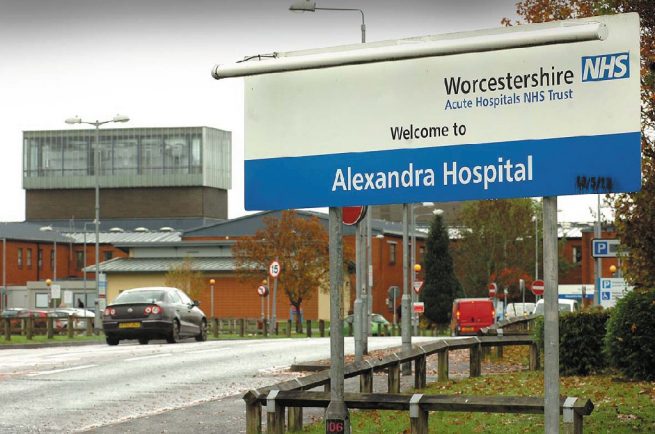
THERE are growing calls for clarity over what exactly can be treated at the Alexandra Hospital after health trust chiefs dramatically revealed that most trauma patients would no longer be taken to Accident and Emergency there.
They come from town MP Rachel Maclean – who was only briefed minutes before the story broke – as well as campaigners from Save the Alex and members of the Redditch public.
Behind it all is the question ‘How will Worcester cope?’ following the revelation that patients are waiting hours in ambulances outside the Royal’s emergency department for to admitted.
“Instead of talking about what they’re taking away from the Alex, the question is – what’s left?” said Ian Johnson of campaign group Save the Alex.
“I wouldn’t know what to do with anybody at the moment.
“Do you take them to the Alex? If they break a bone, do you take them to the Alex, do you send for an ambulance or do you go to Worcester, assuming you can get there?”
He added that Worcestershire Acute NHS Trust had in effect put in place the recommendations of a joint services review from 2011, making Worcester a centre for A&E care and the Alex a centre for surgery.
“It gives us no pleasure but back then we raised these very issues with the trust,” said Ian.
“We had all the protests, and all the marches, the present Health Secretary Sajid Javid even signed our petition.”
Mrs Maclean has sent a three page letter to Matthew Hopkins, the chief executive of Worcestershire Acute Hospitals NHS Trust.
In it she asks what sort of trauma cases will be treated at the Alex, the reasons behind the decision and what the ambulance service has been told.
She also points out that with the Royal under increasing pressure that it seems counter-productive to heap more pressure on it by removing the trauma cases from the Alex.
She further adds: “I am particularly concerned that these changes will exacerbate existing health inequalities as Redditch patients will be required to travel further for treatment.”
Redditch Councillor Mike Rouse said: “This is the implementation of what they said they were going to do ten years ago.
“But a lot has happened over the last ten years.
“We’ve had Brexit, we’ve had Covid, we’ve seen that Worcestershire Royal cannot cope, so why don’t they take a fresh look at it?
“They have had fresh money come in and what they agreed ten years ago does not necessarily mean it’s correct now.”
He added: “Regarding health care, I would say that if anything happens you still need to go to your nearest hospital.
“No matter what you’ve heard if you are ill you go to your nearest hospital and let the professionals make sure you get the right care.”
A trust spokesperson said the Alex would continue to provide a 24/7 urgent and emergency care service including for patients with traumatic injuries.
“As a designated Local Emergency Hospital this means that patients with a wide range of trauma injuries – including falls, head injuries and common fractures – will continue to be seen at the Alexandra,” he said.
Matthew Hopkins, chief executive of WAHT said: “Teams across our Trust are working incredibly hard to deliver the safest, highest quality care possible to all our patients.
“That includes patients needing urgent and emergency care, patients waiting for planned care and patients requiring hospital treatment for Covid-19.
“It’s vital that we make the best use of all our sites and facilities. Our Clinical Services Strategy built on the work done as part of the Acute Services Review and sets out a clear vision for each of our three main sites.
“For surgical services that sees the Alexandra as a centre for a wide range of high quality (and increasingly complex) elective surgery, emergency surgery focused on Worcestershire Royal (including inpatient trauma) and Kidderminster as a centre for the majority of much of our day case and short stay activity.
The benefits to patients include shorter waiting times, reduced risks of cancellation and improved outcomes, as shown in other areas of the country where similar models are in place.
“Progressing this work is important for our patients and our clinical teams, as long as any changes can be made safely, to work towards our long-term strategic vision and our work to recover from the impact of the pandemic in a safe and clinically sustainable way as well as supporting our plans for winter which have been developed with our health and care partners across Worcestershire.”