


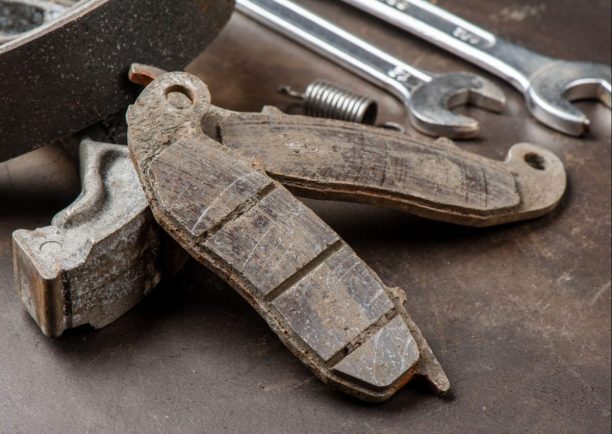
The brake pads are located in the calipers, which are pressed on the entire mechanism by a piston pushed out by the brake fluid.
The entire braking process is based on this circuit – without all components working properly, driving can be really dangerous.
Brake pads need to be replaced from time to time to maintain their effectiveness and ensure safe driving.
A brake pad must:
Be very strong mechanically so that it won’t collapse under heavy loads and the friction material won’t peel away from the steel backing.
Be resistant to high temperatures. Temperatures that occur during emergency braking.
Provide a high coefficient of friction on the brake discs at any allowable wear (have high efficiency), both cold and hot.
Provide a reasonable amount of force on the brake pedal for high braking efficiency, so that it can be performed by a strong man, and a fragile girl at the wheel.
Do not change in geometric dimensions at any temperature so that it does not jam in the caliper.
How does a brake pad work?
Although every driver uses the brakes during everyday driving, many people don’t know how the entire mechanism works.
This is valuable knowledge that will help you not overlook a breakdown and cause an accident.
The process begins by pushing on the brake pad – essentially, the pump forces the fluid to flow to the piston.
This, in turn, clamps the brake pad and presses it against the disc.
The element then rubs against the protective layer.
The result is that the car slows down or stops, depending on the pressure applied.
As every driver knows, pressing the pedal does not stop the car immediately.
Until then, it can take anywhere from a few to a few dozen seconds, depending on the speed of the car.
Information on how much force should be applied to the brake pad to make the car stop as quickly as possible can be found in driving manuals.
With this knowledge, you can also understand how long the braking distance is at a certain speed and how important it is to react quickly.
Causes of brake pad wear or damage
● Burned friction material: it is brittle and cracked in structure;
● Very poor braking
● premature wear and tear;
● damage to the friction material.
How do I take care of my brake pads?
Although each brake pad needs to be replaced after about 20-50 thousand miles, you can really make a difference in their condition on a daily basis.
Through proper driving, you’ll extend the life of the blocks and thus take care of your car.
The most important rule of thumb is thoughtful braking.
When you’re driving around town or outside populated areas, try to use the engine to slow down and stop the car. Shift gears frequently and efficiently.
Changing old pads or discs for new ones
The sequence of actions is as follows:
– The car should be raised with a jack, making sure that the structure is stable and safe:
– remove the wheel;
– Using a flat screwdriver, push in the caliper piston;
– Remove the pressure spring, which holds the brake pad in the caliper;
– Release the caliper from the bolts that hold it in place and lift it over the brake disc (taking care not to damage the attached brake tubing);
– Remove the old pad and install the new part, following all the steps described in reverse order;
– pump the brake pedal with several strokes.
With the apparent simplicity of this operation without experience and skills for it is better not to take up. Especially since you can always ask for help from professionals.
Running in of pads after replacement
New brake pads and discs definitely need a running-in period:
– after leaving the workshop on a straight and safe road at the first opportunity, try to make sure to perform several cycles of acceleration to 80 km/h and braking to 25-30 km/h at intervals of 5-10 minutes.
– The first kilometers of mileage after replacement, do not forget that you need to brake smoothly, avoiding increased loads on the brake mechanism. And subsequently for a while you can not drop the high speed, the brake pedal to the floor with a sharp movement – pressing should be intermittent.
It is important to remember that untimely replacement of brake pads and discs can cause distortion or jamming of calipers, mechanical damage to worn parts of the brake system and even its complete failure.
So do not forget to pay proper attention to their condition – for the sake of confidence in your own safety!
Information by: Information about brake pads rear and front for car from autodoc.co.uk