



The most awkward figure in Britain’s illegal gambling debate is not the largest one.
A recent industry estimate put the 2025 black market at about £800m in gross gaming revenue, against roughly £8bn for licensed online operators. That points to channelisation near 91%, a rate many regulated markets would gladly take.
Those figures don’t make the UK gambling black market harmless. They do, however, make the easy version of the argument harder to sustain. Britain may have a well-channelled online market, yet the illegal sector remains difficult to measure, easy to inflate and dangerous when consumers fall through the regulated net.
The Measurement Problem Behind the Black Market Argument
The UK Gambling Commission has spent the past year trying to move the conversation away from headline-grabbing estimates. Its research into illegal online gambling has been cautious because the data does not behave like normal market data.
In its September 2025 report, the regulator said the illegal market creates a “high risk of consumer detriment” and described its own trend work as early-stage. Tim Livesley, the Commission’s head of data innovation, later wrote that the updated trendline did not show a “consistent or sustained growth” in consumer engagement over the 21 months studied.
That doesn’t close the argument completely, of course. Web traffic, VPN use, and offshore domains leave partial signals. Some are visible. Many are not. Ultimately, the cleaner the number sounds, the more questions it usually deserves.
Why the Big Figures Keep Talking Past Each Other
Public debate often blends stakes, visits, gross gaming revenue, and advertising spend as if they measure the same thing. That’s simply untrue, as a high-stakes figure can sit beside a much smaller GGR estimate.
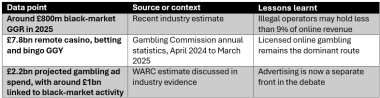
BGC chief executive Grainne Hurst has described the illegal market as “real risk, real harm,” while industry evidence has challenged broad advertising estimates that conflate regulated and offshore spend.
The market is real, yes. But the wrong metric can still make it look like something else entirely.
Tax, Enforcement and the Channelisation Test
Remote Gaming Duty rose from 21% to 40% from April 2026, while a new 25% remote betting duty is due from April 2027. The government said the changes would raise more than £1bn a year, while acknowledging that some consumers could respond by moving to the illegal market.
That is where regulated gambling market policy becomes delicate. Licensed operators face higher taxes, tighter compliance, and more scrutiny. Unlicensed gambling sites avoid those costs, but they also sit outside British protections on identity checks, safer gambling tools, dispute routes and self-exclusion.
The enforcement response has become more practical. In May 2026, the government published the Illegal Gambling Taskforce terms covering payments, online advertising, and cross-agency enforcement. The Gambling Commission has also welcomed £26m over three years to combat illegal gambling.
The Licensed Boundary is Important for Consumers
For many customers, the legal distinction isn’t obvious. An offshore casino can have slick branding and a payment page that looks no different from a licensed site. The Commission has warned that some illegal websites look indistinguishable from legal ones, which is why licensing remains a useful talking point.
Such context is where resources comparing UK-licensed casinos that accept Apple Pay can add value, provided the emphasis stays on licence status, payment traceability and consumer protection rather than convenience alone. The payment method is not the safeguard. The British licence is.
It’s important to note that the Commission’s research adds another wrinkle. Some people who use illegal sites may already be self-excluded by licensed operators. Treating every black-market pound as revenue waiting to be “won back” misses the consumer-protection issue underneath the commercial one.
A Smaller Share Can Still Be a Serious Problem
A 91% channelisation rate suggests Britain’s online regime is still doing something many jurisdictions envy. The same estimate leaves hundreds of millions outside UK oversight. Add higher gambling duties and harder-to-police advertising channels, and the risk becomes less about one dramatic number than the slow erosion of the licensed boundary.
The UK black-market debate now needs fewer theatrical estimates and more disciplined definitions. Overstating the threat can lead to bad policy. Underplaying it can leave consumers where no regulator, operator, or dispute process can reach them.
Britain is not facing a collapse in channelization, but a visibility problem, and hidden markets punish certainty first.
Article written by