


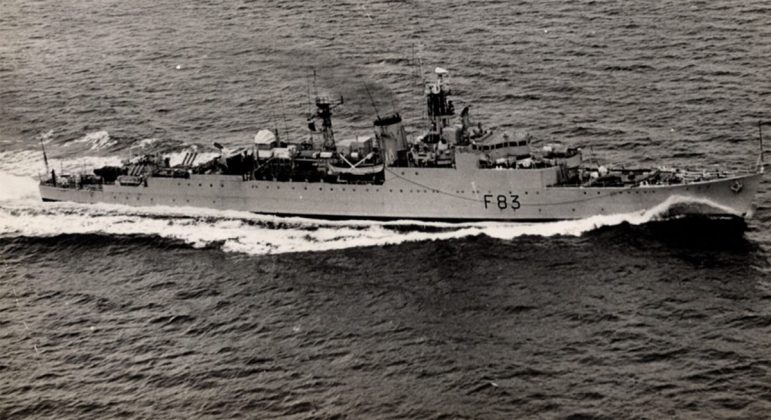
INSPIRED by ‘a very full life’ Redditch man Roger Henry Lippett has written a book on his life which began living on the Batchley Estate. He went on to serve in the Royal Navy and wants to share his story.
He was born on January 30 1939 on the council estate, with his dad’s name Henry, being given to him as his middle name.
Here he sheds light on his life family and friends as a social record of sorts that may be of interest to his children, grandchildren and the people of Redditch.
Although he said he had never achieved great wealth or fame he felt his life had moments worth recounting.
In his words: “I now live in the beautiful city of Plymouth in Devon but I will always be a Batchley boy.
“Far have I traveled, and much have I seen and this is my story, serialised in the Redditch Standard.”
Part 11
The ship had been worked up to a state of high efficiency, we were deemed fit to be actively deployed and our first mission was not one we expected or were excited about.
We discovered we were to be sent to patrol the seas around Iceland to protect British fishing interests from the attention and harassment from Icelandic gunboats.
This was known as The Cod War.
It was all to do with fishing rights and although no shots were fired – by the British anyway – the confrontation led to many dangerous situations.
There were two so called ‘Cod wars’ and I was involved with both of them.
We left Devonport on September 27, 1958, and proceeded up through the Irish Sea and north to Iceland.
It was grey and miserable weather on passage and got worse when we reached Icelandic waters.
Our patrol area was vast and includes the waters to the south of Iceland and inside the Arctic Circle to the North.
Our task was to shadow the British fishing vessels and put ourselves between them and the Icelandic gun boats which were harassing them and intimidating them by cutting the fishing vessels nets and equipment adrift.
These were dangerous manoeuvres and often led to collisions between warships and gunboats.
The warships were not designed for this type of activity.
They were designed for stand-off warfare conducted at a distance and, with their thin plating, we often came off worse against the sturdy thick plated gunboats.
We were not allowed to use gunfire against the gunboats although there were, I understand, occasions when they did fire shots at British vessels.
These were long weeks circling Iceland in weather that remained grey and stormy throughout.
Often the waves were huge. If we were heading into the seas, the bow would plunge into the wave and become completely submerged with the wave washing right over the forecastle and up to the bridge and the propeller screws racing as – with the bows submerged – they became clear of the water.
Then the bow would fight its way up from the foaming mass of water and the ship would appear to shake itself like a dog emerging from a stream.
I would watch with a sense of awe, fear, and excitement as the huge mass of water slammed against the ships side causing it to heel over.
Anything not lashed down would be thrown around all over the place.
On one occasion we neglected to lash a fire extinguisher to its bracket and it got thrown across the mess which set it off resulting in this heavy piece of equipment causing considerable damage and spraying foam in every direction.
Life was a bit grim with daily struggles to stay on one’s feet and grope around the ship whilst hanging on.