

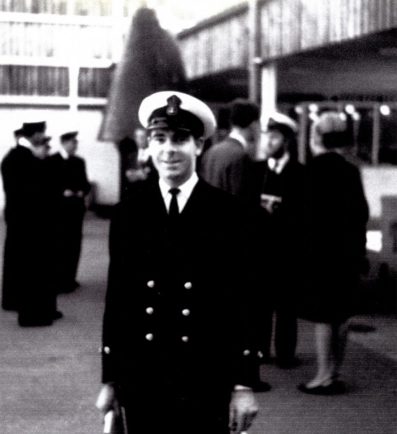
INSPIRED by ‘a very full life’ Redditch man Roger Henry Lippett has written a book on his life which began living on the Batchley Estate. He went on to serve in the Royal Navy and wants to share his story.
He was born on January 30 1939 on the council estate, with his dad’s name Henry, being given to him as his middle name.
Here he sheds light on his life family and friends as a social record of sorts that may be of interest to his children, grandchildren and the people of Redditch.
Although he said he had never achieved great wealth or fame he felt his life had moments worth recounting.
In his words: “I now live in the beautiful city of Plymouth in Devon but I will always be a Batchley boy.
“Far have I traveled, and much have I seen and this is my story, serialised in the Redditch Standard.”
Chapter 16
WE managed to fit in two weeks leave before returning to the ship and it was with a heavy heart that I kissed and bade goodbye to Rose and baby Susanne not knowing how long it would be before I would be home to them again.
Rose waved me off at Waverly Station as she would do many times and it seemed a long journey back to Plymouth.
The only ‘luxury’ item I managed to obtain for Rose before I left was a small 12 inch black and white television which I managed to purchase from a friend for £5.
Television was relatively new then so this was a welcome item of entertainment even though it was only possible to get two channels, BBC1 and BBC2.
The ship re-commissioned on February 9 1962 and a Royal marine band played and the padre blessed the ship and all who sailed in her.
It was a very formal occasion and families who lived near were able to attend the ceremony.
We spent the next few weeks checking over the machinery and equipment and to doing sea trials before sailing to Portland for the dreaded workup.
The next three weeks were to see every possible situation thrown at us.
The ship would often be wreathed in smoke below decks and on the upper deck we were aware of the dull thud of the frur inch gun and the whoosh of the anti-submarine mortars which was our main weapon, Ulster being an anti-submarine frigate.
The mortars consisted of two triple mounted tubes, one set to port and the other to starboard.
A pattern of six bombs would be fired over the bows of the ship set to explode three above and three below a submarine in order to create maximum effect.
This was a huge advance on the depth charges carried in the last war which Ulster was originally fitted with.
All ships went through this workup routine before assuming their duties.
We returned to Devonport on March 19 1962. It was then that disaster struck for real. After all the simulated situations a real fire occurred on board. It happened early in the morning and from what I understand was caused by a deep fat fryer in the galley.
The fire took hold and grew in intensity to the extent that the galley was gutted and the aluminium ventilation trunking became molten metal. Ulster was a small ship and the galley was only a short distance along the main passageway from the ERAs mess.
As the fire spread the shore fire brigade arrived to help tackle the fire and eventually it was brought under control. The first I knew of the fire was when I was awakened in my hammock to the sound of shouting and steel boots on the deck outside the mess door.
When I looked out it was a scene of chaos with thick acrid smoke and water everywhere, and firemen dragging hoses. I was the only one not evacuated! It turned out that I had slept through all the noise and commotion. No one had realised that I was still in my hammock.
This comes close to being another of my nine lives as the ERAs mess was just above the fuel tanks and adjacent to the four inch shell, storage and also the stowage for the anti-submarine mortar bombs all of which would have made a rather large bang had the fire reached them.
The damage was considerable. All the electrical cables to the four inch gun had been through as well as all the other damage which delayed our sailing for several weeks.
We eventually left for the West Indies after fueling and once again our first port of call was Punta Delgado in the Azores. After a calm crossing of the Atlantic we arrived at our Ireland island base on April 28 and tied up alongside.