

INSPIRED by ‘a very full life’ Redditch man Roger Henry Lippett has written a book on his life which began living on the Batchley Estate. He went on to serve in the Royal Navy and wants to share his story.
He was born on January 30 1939 on the council estate, with his dad’s name Henry, being given to him as his middle name.
Here he sheds light on his life family and friends as a social record of sorts that may be of interest to his children, grandchildren and the people of Redditch.
Although he said he had never achieved great wealth or fame he felt his life had moments worth recounting.
In his words: “I now live in the beautiful city of Plymouth in Devon but I will always be a Batchley boy.
“Far have I traveled, and much have I seen and this is my story, serialised in the Redditch Standard.”
Part 19
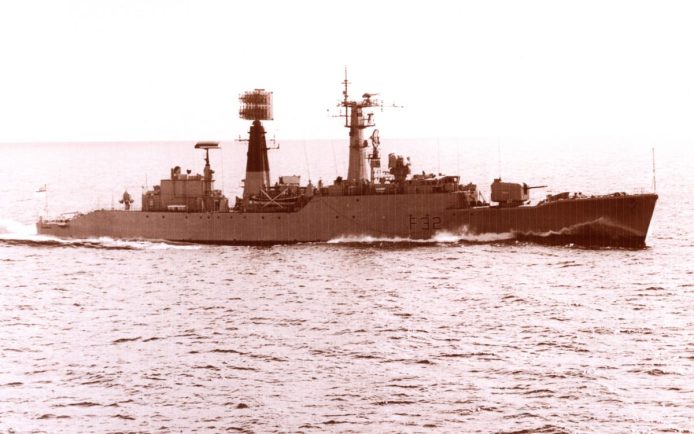
ON JANUARY 8th 1965 I was drafted to HMS Salisbury a diesel powered aircraft direction frigate.
Salisbury was a much more modern ship than HMS Ulster but not as fast.
Her eight 16 cylinder diesel engines gave her a long range but a top speed of about 24 knots.
She carried two large lattice aerials which we referred to as bedsteads and was designed primarily to detect aircraft at long range and so be able to warn the fleet.
So began a long association with this ship.
We lived in the barracks (HMS Drake) for some weeks while we tuned the engines and generally brought the ship up to a liveable and efficient condition.
We then moved all our kit on board and sailed for the naval base at Portland for the dreaded workup where we were hammered into a smooth and efficient working unit.
We were deployed to Arctic patrols around Iceland during what was known as the “Cod Wars” so once again I found myself involved in this conflict
and it would not be the last time.
It was an uncomfortable time for most days it was grey skies and huge waves which buffeted our small ship making life on board very difficult.
Often it was a case of hanging on as the ship rolled and pitched in the heavy seas and doing the bare minimum consistent with keeping the ship under way and keeping in contact with the fishing vessels we were protecting.
Often it was too dangerous for the galley to operate and so it was often a case of tea and the old stand by corned beef ‘sarnies’ I dread to think what the conditions were like on the fishing vessels.
We were often closed up at defence stations (damage control stations) when collision with an Icelandic gunboat was imminent, as our thin plated vessels did suffer considerable damage as they were not designed with this type of operation in mind.
We were to be deployed to our base in Singapore to operate with our Commonwealth allies Australia and New Zealand in the Indonesian conflict the political details of which can be researched on line but basically the situation was as follows.
President Sukarno of Indonesia was opposed to the formation of the new state of Malaysia and which he opposed by force. Our task along with our allies was to support the development of the fledgling new country using whatever means necessary. The conflict took part between the years 1962 to late 1966.
As well as navy activity land forces from the armies and marines from the other countries were involved, indeed the navy’s main task was to support these forces.
It was wonderful to be on leave with my family but at the back of our minds was the thought that I would soon be leaving them and it would be more than a year before we would all be together again.
When the time came I made a taped Christmas message for them to listen to on the day reminding them how much I loved them and that they would always be in my thoughts. We exchanged Christmas presents and when the time came we said our goodbyes on Waverley station and tears were shed.
I felt sad and it was with a heavy heart that I commenced the long lonely train ride to Plymouth.
However it was my job and the lot of a service family and once on board and I met up with my shipmates it was a matter of getting on with it.