

INSPIRED by ‘a very full life’, Redditch man Roger Henry Lippett had written his memoir. From growing up on the Batchley Estate, he went on to serve in the Royal Navy and wants to share his story.
He was born on January 30 1939 on the council estate, being given his dad’s name Henry as his middle name.
He sheds light on his life, family and friends as a social record that may be of interest to his children, grandchildren and the people of Redditch. Although he said he had never achieved great wealth or fame he felt his life had moments worth recounting.
In his words: “I now live in the beautiful city of Plymouth in Devon but I will always be a Batchley boy.
“Far have I travelled, and much have I seen and this is my story, serialised in the Redditch Standard.”
Part 2
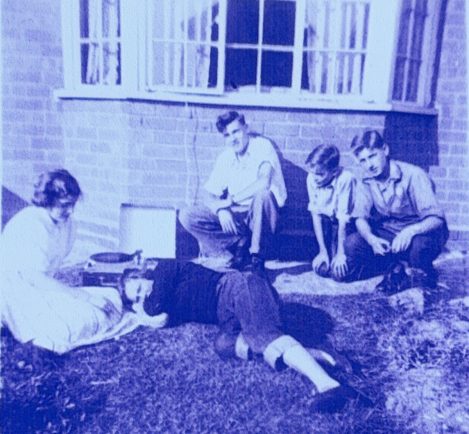
The 1940s and 50s were wonderful years to grow up in. True, we were poor in financial terms but as children I feel we did not lack anything.
Council housing was a fairly new concept in that it provided much-needed homes after the war after so many houses had been destroyed by German bombing.
It catered for the large portion of the population who could not afford to buy.
Batchley Estate during my early childhood was quite small compared to the very large estate it eventually became. Initially it comprised Batchley Road, Ashtree Road, Hazel Road and Birchensale Road, and was an area surrounded by fields, farmland, woods and countryside.
Continual building over the ensuing years resulted in the large housing estate it eventually became.
This was more than just a house; it was my childhood home. I experienced summers and winters, Christmases and birthdays.
This modest council house is a bank of mostly happy memories – I remember every detail.
It also describes a way of life long gone.
Most of the houses were three bedroomed semi-detached, but our house was actually in a block of four.
There was what we called ‘the entry’ in between the middle two houses which led from the front of the houses to the back, like a tunnel.
The front door opened onto the stairs and immediately to the right was a door opening on to the living room – only we called it the front room.
We had thin curtains across the bay windows, and a heavy blackout curtain, which had to be drawn as soon as it got dark in order to cut out any chinks of light which might be seen by German bombers.
Air raid wardens patrolled the streets and would knock at the door and tell you to draw the curtains properly if any light was showing.
Redditch was only about 15 miles from Birmingham which was regularly bombed and was targeted by the Luftwaffe because of the importance of its factories that were crucial to the war effort.
These included Britannia Batteries, The Royal Enfield and the BSA.
Enemy aircraft also machine gunned the town and surrounding areas and I remember my auntie Vi telling me how, when she was in the garden of Elmhurst in Alvechurch, a German plane swept over them so low that they could actually see the pilot laughing at them as they threw themselves flat on the lawn.
Many people were killed and numerous houses were destroyed.
Although we were poor by present day standards, we did have a healthy diet, which was possible because of our allotment. I was interested in plants and gardening from a very early age and I loved going down to the allotment with my dad.
We grew all sorts of vegetables including potatoes, cabbage, sprouts, carrots, parsnips, lettuce and many other things.
I remember there was a little pond away in the far corner of the allotments behind the fish hook factory on Windsor Road where we would go to dip the watering can in to carry water for the plants.
I know I had a very happy childhood.
Today many children have more in the way of material things such as mobile phones and video games etc, but we had freedom.