

INSPIRED by ‘a very full life’ Redditch man Roger Henry Lippett has written a book on his life which began living on the Batchley Estate. He went on to serve in the Royal Navy and wants to share his story.
He was born on January 30 1939 on the council estate, with his dad’s name Henry, being given to him as his middle name.
Here he sheds light on his life family and friends as a social record of sorts that may be of interest to his children, grandchildren and the people of Redditch.
Although he said he had never achieved great wealth or fame he felt his life had moments worth recounting.
In his words: “I now live in the beautiful city of Plymouth in Devon but I will always be a Batchley boy.
“Far have I traveled, and much have I seen and this is my story, serialised in the Redditch Standard.”
Chapter 26
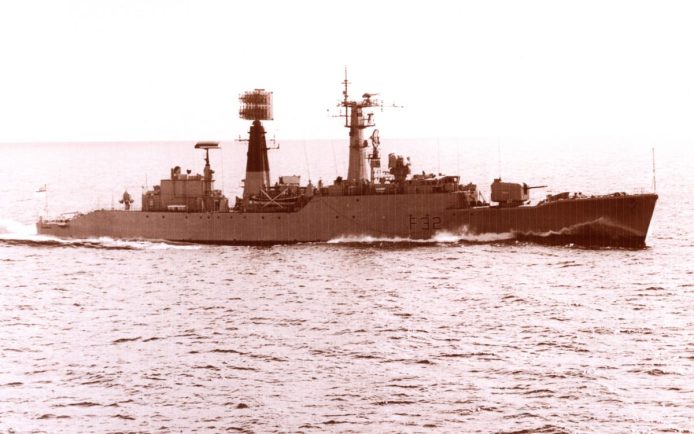
THIS spell ashore lasted until March 25 1976 when once again we were to take part in the “Cod War” and we put to sea bound for Iceland.
We arrived at Rosyth on March 28 and I managed to slip ashore to phone Rose from a phone box in the dockyard.
We reached Icelandic waters on March 30 and began patrol duties protecting British fishing vessels.
It wasn’t long before we encountered the Icelandic gunboat Tyr resulting in an eight hour confrontation in which we suffered serious damage after a collision.
At the time the seas were raging heavy and the skies were grey.We had placed ourselves between the fishing vessel and Tyr at what was known as ‘Riding off stations’.
We were as usual closed up at our damage control stations of which I was in charge of the after damage control station.
Suddenly there was a large bang and the ship shuddered under the impact as we collided with Tyr.
Back aft we were all catapulted forward onto the deck as the ship reeled under the impact.
We suffered damage to the hull, our boats on the davits were smashed and damage was also sustained to some of our superstructure.
We were in a sorry state when we eventually limped back into Devonport dockyard with caved in plates,
wrecked boats, and the paintwork stripped away and rust stained as a result of the battering from the
powerful waves and strong icy winds.
At no time were Royal Navy vessels allowed to fire upon the Icelandic boats but that was not the reverse case and there were instances when the Icelanders fired upon fishery protection vessels.
One such ship fired upon was the British Star Aquarius, an unarmed fishery protection vessel.
Other vessels were fired at with rifle fire, in one case damaging ships boats and the bridge.
The Second Cod War finally came to an end on May 28 976 with an agreement highly favourable to Iceland.
British vessels lost access to rich fishing areas ant thousands of jobs were lost.
The UK had no option as to accept the agreement as there was a large US NATO air base on Iceland and Iceland threatened to leave NATO if we did not agree to the conditions offered so, with international opinion against us, they had Britain over a barrel and we were forced to accept the terms.
I was serving on HMS Ulster for the first Cod War in 1958 and there at the close on HMS Salisbury in 1976, all of which came to nothing.
Around 37 Royal Navy ships were involved at great cost and it can only be said that the Navy played its part and carried out this thankless task to the best of its ability under difficult circumstances
When we entered Devonport in May 1976, although I didn’t realise it at the time, it, my time serving at sea with the Royal Navy had come to a close.
However, as things were to turn out, it would not the last time I would earn my living on the seas.
On arrival in port I was drafted once again to the shore base HMS Defiance which was a large depot ship with workshops but later it became a purpose built base ashore with better facilities.
I didn’t enjoy being based ashore but once again it was the fact that I was able to enjoy a home life which made it acceptable.
On June 21 1976 I was transferred from static fleet maintenance group (FMG) to mobile FMG which meant that as well as working on ships in Devonport I was also to be available to work on ships wherever they might be in the world.
It wasn’t long before the group was called upon to be sent to Jacksonville, Florida, to work on HMS Ark Royal.