


“AI chatbot” is a broad label. Some chatbots are productivity tools; others are companions; others are therapy-adjacent (often problematically).
Joi AI’s own Terms describe the product as mood/wellbeing software and explicitly state it is nothealthcare, therapy, or emergency support.
That framing is important because it defines what a responsible user should expect: supportive conversation and entertainment, not clinical outcomes.
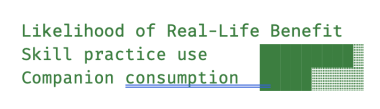
Two ways people use companion chatbots
Mode 1: Companion consumption
● goal: comfort, attention, entertainment
● risk: habit formation, time drift, replacing real social effort
Mode 2: Skill practice
● goal: improve messaging, boundaries, conflict de-escalation, dating scripts
● risk: over-rehearsal without taking action (avoidance)
A high-quality review should assess whether the product supports Mode 2—because Mode 2 tends to improve real-world outcomes.
What Joi AI publishes that matters for chatbot evaluation
- Text + voice interface mentioned in the Terms.
- Human moderation “in some cases” to enhance chatbot activity.
- SFW content limits and prohibited content categories.
- Safety claims about real-time safeguards and red-teaming.
These are meaningful because many “AI chatbot” apps provide none of this in writing.
Graph: value vs risk depends on usage mode (conceptual)
Practical coaching drills that an AI chatbot can support
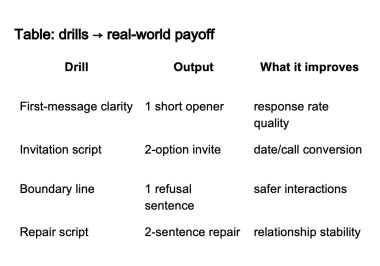
These drills are designed to translate into real dating and relationship behavior. They work best with a strict time limit (15–25 minutes) and a “take one output and stop” rule.
Drill A: First-message clarity
● Goal: write a message that is short, specific, and easy to answer.
● Success metric: the message contains one concrete detail and one question.
Drill B: Invitation script
● Goal: convert chat into a plan without pressure.
● Success metric: includes two time options and a graceful “no problem” exit.
Drill C: Boundary line
● Goal: say “no” without apology spirals.
● Success metric: one sentence, calm tone, no over-explaining.
Drill D: Repair script
● Goal: apologize and specify change.
● Success metric: apology + one behavioral commitment.
The “under-discussed” pitfall: false intimacy
Companion chatbots can simulate closeness without reciprocity. That can feel soothing, but it can also lower motivation to do the messy, slow parts of human connection (negotiation, conflict, vulnerability).
A practical self-check:
- After a session, does motivation to text a friend/date go up or down?
If it consistently goes down, the chatbot is functioning as replacement, not support.
Data and privacy: treat it as sensitive
Joi AI’s Privacy Policy describes retention and deletion rights and notes that deletion may not remove emails/data already shared with certain third parties or cached beyond the company’s control.
For chatbot users, that means:
- don’t treat the chat as a diary
- avoid identifying details
- avoid content that would be harmful if disclosed during a billing dispute (the Refund Policy notes disclosure may occur in chargeback contexts).
Safety posture: how guardrails change the coaching usefulness
Because Joi AI says it is SFW and prohibits explicit content, it may be more useful as a communication practice space than as an “anything goes” fantasy space. Users practicing respectful invitations, boundaries, and supportive language typically benefit from stronger guardrails.
As an AI chatbot product, Joi AI looks comparatively structured in published policy: it defines the service, limits it to SFW, and frames it as mood/wellbeing software rather than therapy. The strongest use case is skill practice—drafting messages, rehearsing boundaries, and improving clarity—paired with strict time limits so the tool supports relationships instead of replacing them.