


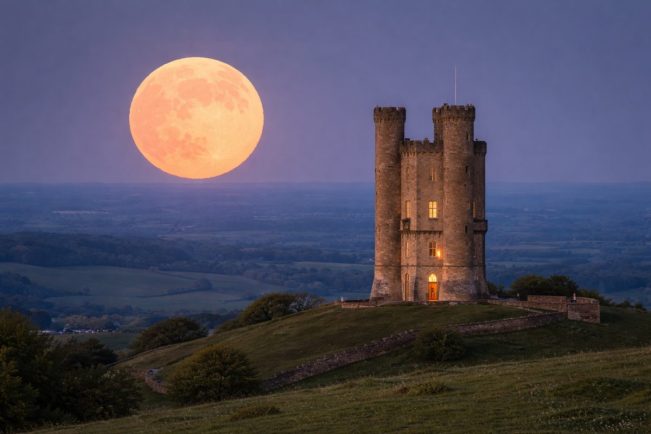
April’s full Moon, known as the Pink Moon, will reach its peak illumination at 03:12 BST on Thursday 2 April, providing one of the most significant lunar events of the spring for observers across the UK.
Despite its name, the Pink Moon will not appear pink. The term originates from seasonal naming traditions rather than any visual characteristic.
Early communities, particularly in North America, used full Moons to track the passage of time, naming each one after natural events or environmental changes occurring during that period. The April full Moon takes its name from the blooming of pink ground phlox, a widespread spring flower.
The naming system reflects a broader pattern. Other traditional names for April’s full Moon include the Sprouting Grass Moon, the Egg Moon and the Fish Moon, each linked to seasonal renewal, agricultural cycles or animal behaviour. These labels served as practical markers in societies that relied on close observation of nature.
In the UK, the Moon may appear orange or reddish when it rises on the evening of 1 April. This effect is caused by atmospheric scattering. As the Moon sits low on the horizon, its reflected sunlight travels through a thicker layer of the Earth’s atmosphere. Shorter wavelengths of light, such as blue and violet, are scattered more strongly, leaving longer wavelengths, reds and oranges, to dominate the Moon’s colour.
The April full Moon also plays a central role in determining the date of Easter. In the Christian calendar, Easter falls on the first Sunday after the first full Moon following the spring equinox. Although the astronomical equinox can occur on either 20 or 21 March, the Church fixes it at 21 March for calculation purposes. In 2026, the equinox occurs on 20 March, making the 2 April full Moon the first after this date. Easter therefore falls on Sunday 5 April.
The lunar cycle is equally important in the Jewish calendar. Passover begins on the 15th day of Nisan, the first month of the religious year, which coincides with the full Moon. This places the festival in alignment with the same lunar phase as the Pink Moon.
Weather conditions may affect visibility across the UK. Forecasts indicate a cold front moving south across England and Wales around the time of the full Moon, likely bringing cloud and rain. Clearer conditions are expected further north, particularly in Scotland and Northern Ireland, where colder air behind the front may allow for breaks in cloud cover.
For observers, the best chance to view the full Moon will be either shortly after moonrise on the evening of 1 April, when it appears low on the eastern horizon, or in the early hours of 2 April, when it reaches peak brightness.
While it may not live up to its colourful name, the Pink Moon remains a notable point in the astronomical calendar, linking seasonal change, cultural tradition and precise celestial timing.
If you capture the Moon at its best, readers are encouraged to send in their photographs in to this newspaper, sharing views of this springtime spectacle from across the region.
Main Image: For illustration purposes only.