


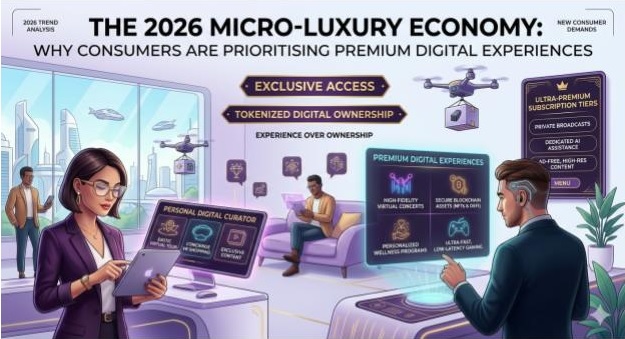
As we traverse the highly dynamic economic backdrop of 2026, a fascinating and profound shift in consumer behavior has taken hold: the undeniable rise of the “micro-luxury” economy. Rather than investing in capital-intensive production on a large scale, today’s consumers are increasingly looking for good, accessible moments of escape through premium digital platforms.
From the implementation of ultra-HD 8K streaming services to the elegant and interior-design-inspired interface of today’s digital entertainment hubs, the worldwide focus has finally changed. Luxury in the modern age is no longer defined strictly according to a physical price tag; instead, it is defined by the quality of the interface, the absence of friction, and the depth of the immersion. We’ll dive into the economic shifts driving this change in consumer behavior, and look at how the digital world is stepping up to deliver high-end, accessible experiences.
The Macroeconomic Architecture: Why We Are Reallocating Budgets
To see where the explosion of the micro-luxury economy can be found, we must look at the macroeconomic scaffolding of 2026. The global economy is presently dominated by rapid technological disruption and a stark bifurcation in the spending power of consumers. With tariff-led inflation clawing its way to about 5% in affected markets, and wage growth remaining stagnant for many, households are fundamentally recalculating what makes up an essential expense.
Consumers are actively postponing large purchases – for white goods and major home appliances – in favour of holding onto older models. However, this overall fiscal conservatism has not led to a total stop on spending. Instead, it has given birth to the “Gen Z Paradox.”
Generation Z and younger Millennials, who are expected to have a whopping $12 trillion in global spending power by 2030, approach consumption with a highly selective, emotional calculus. While data shows that 82% of Gen Z consumers are happy to purchase “dupes” (cheaper alternatives to premium goods) in order to save money on everyday essentials, consumer behavior immediately abandons this wariness if a purchase carries a lot of emotional weight or cultural relevance.
Psychologically, consumer forecasting experts point out, in an unpredictable world, buyers are desperately looking for “glimmers,” micro-moments of joy, comfort, and safety that represent the psychological opposite of triggers. These micro-luxuries are important coping mechanisms. In the digital world, this means a huge willingness to pay a premium for uninterrupted, high-fidelity digital sanctuaries.
The Streaming Paradigm: Gating Premium Features
As physical leisure activities are squeezed by inflationary pressures, the home digital entertainment sector has taken advantage of the huge demand for accessible luxury. However, the times of artificially suppressed, cheap subscription fees are gone.
Faced with the challenges of profitability, streaming platforms in 2026 have taken a very structured, “menu-like” approach to pricing. Budget-conscious consumers are being funnelled to Free Ad-supported Streaming TV (FAST) channels, which imitate traditional broadcast television with tolerable loads of adverts. Meanwhile, users who want digital micro-luxuries are choosing to spend on high-end premium tiers.
For the consumer who is willing to invest, the technological ceiling is drastically raised. The new standard for premium delivery is 8K video infrastructure (7680×4320 resolution), with quadruple the resolution of standard 4K. Backed up by high-tech AV1 encoding and 5G cellular networks, this enables sub-3-second latency across the globe. This near-real-time delivery is turning passive viewing into an active ecosystem and making extensive use of volumetric and spatial capture technologies to provide a sense of physical presence for viewers of live concerts and sports.
Gaming and the Blueprint for Digital Elegance
Nowhere is the micro-luxury trend more aggressively played out than in the digital gaming sector. In some areas, such as the UK, adoption of gaming has gone beyond ever before, with 70% of adults playing them, and they have moved from being a niche hobby to becoming the main form of digital socialisation. Over half of Gen Z respondents explicitly say that they make real-life friendships as a result of digital play.
Modern consumers are no longer satisfied with mere layouts, but they want immersive settings and smooth performance. A prime example of this trend can be found in the high-end design of modern online casinos that have abandoned the simple concept of being a gaming site and have instead evolved into sophisticated entertainment hubs. Combining elements of live streaming technology, beautiful aesthetics, and ‘Trust by Design’ mechanics, these platforms help deliver a premium experience to emulate the exclusivity of high-tier digital platforms.
These higher-end iGaming sites have completely abandoned the hyper-stimulating, neon-drenched look of the early internet. Instead, developers are making use of luxury interior design principles. Digital wood pulp panel accents, marble textures, velvet visual motifs, and ambient light gradients are now the norm. By replicating the relaxing and structured environment of a premium hotel lobby, these platforms evoke a supreme sense of exclusion and massively reduce cognitive load. Furthermore, real-time 8K streaming is extended with live data dashboards through interactive Augmented Reality (AR) functionality, which makes mobile devices powerful live data dashboards without interfering with immersion.
The New Aesthetics of Digital Luxury: Tactile Maximalism
The design philosophies driving the micro-luxury economy spread throughout all digital touchpoints in 2026, governed by three core principles: Immersion, Intimacy, and Intelligence.
The rigid and flat pixels of traditional web design have been replaced by “Tactile Maximalism” and the “Squishy UI.” Digital elements are now made to look physically responsive with the use of glassmorphism and morphing scroll interactions. Visually, pure white backgrounds have been ditched for elevated, muted neutrals. Highly curated color pairings – like Royal Noir Gold (luxurious matte black with warm gold) and Carbon Mint (glowing mint over deep anthracite) – signal absolute premium status, and project high-performance precision.
This is all powered by Agentic UX and AI-driven predictive systems to create “Multimodal Experiences” where interfaces dynamically flex based on real-time context, moving seamlessly between voice commands, spatial gestures, and tactile inputs.
Digital Privilege and the Return to the Physical World
While the digital micro-luxury economy is booming, its actual lasting impact is dependent on a balance with the physical world. In 2026, a fascinating counter-trend has developed: “Digital Privilege.” Because hyper-connection is now an inevitable utility that is expected of all, true luxury is finding the exceptional ability to voluntarily detach from the digital ecosystem without suffering professional or social repercussions.
Local initiatives are recognizing this need for balance. For example, the ReNEW project in Redditch and Bromsgrove is a beautiful example of combining digital with physical community building. Through programs such as Awe & Wander and Gateway to Nature, local governments have been using premium digital arts to put people in touch with the urban greenspace, proving that digital tools can be used to enhance, not replace, physical connection.
Article by Jack Harris.